Tuesday, February 26, 2013

179: The Self-Empowered Woman: MAKERS

Dear Followers,

In case you missed Tuesday night's three-hour program (MAKERS: Women Who Make America), I strongly urge you to check local listings for when the program will be re-aired on your PBS station.

Narrated by Meryl Streep, the show outlines the progress that women in America have made since the 1950s.  Starting with the publication of Betty Friedan's book The Feminine Mystique (which hit book stores 50 years ago this month), MAKERS does an excellent job of visually reminding us of the gender roles that dominated this country for so long.

Warm first-person interviews with high achieving women like Judy Blume, Oprah, Sandra Day O'Connor, Gloria Steinen and Hillary Clinton let the viewer feel like she is having a lively conversation with someone who has (happily) conquered old stereotypes and discrimination.

There is great newsreel footage of the first woman (a 20 year old college student named Katherine Switzer) to run in the Boston Marathon. Even though she finished the race the AAU didn't formally accept female participation in marathons until 1971.

Many women of my era remember all too well the days when females were considered "strange" if they wanted more out of life than domestic concerns.  This program should be required viewing for any woman under the age of 40--the generation of females who "can't imagine" a world without economic independence or strong female role models.

We all need to "remember" that when Oprah started her TV career in Baltimore, she was paid $22,000 a year while her male co-host was paid $50,000.  And I particularly liked the late Nora Ephron's statement that--for many women--their first brush with feminism arrived with their first divorce.

To learn more about this amazing program, which took eight years to make, visit the show's website www.makers.com .

Looking forward to your comments...

Sunday, February 17, 2013

178: The Self-Empowered Woman: Hillary Clinton

Dear Followers,


Sorry I haven't posted in so long, but I've been down for the count with  a nasty case of flu--I'm finally on the mend, and overdue to write about yet another high-achieving woman. And thanks to the suggestion of my faithful French follower, Philippe Drevet, this short blog will remind all of us of what an amazing woman Hillary Clinton is.

I wrote about Hillary's mother (Dorothy Rodham, 1919-2011) in November, 2011, shortly after her death and there can be no question that having a strong supportive mother had a positive impact on Hillary's life.

Below, you'll find a few statistics (thanks to Gail Collins of the New York Times) that illustrate what a hard worker she has been.

We already know a great deal about Hillary, and it's no surprise that her teachers in Park Ridge, Illinois loved having her in their classrooms.  In high school she was a National Merit Finalist, and graduated in the top 5% of her 1965 class.

Now that she has retired as Secretary of State, here are a few statistics to give you an idea of how hard she worked during the past four years.  During that time she:

traveled 956,733 miles
had 1,700 meeting with world leaders
visited 112 different countries
ate 570 airplane meals

And, as the first female Senator from New York (as well as the first American First Lady to ever run for office), she:

visited 62 countries
watched 45 parades
attended 4,600 events in New York

During the 2008 presidential race, she campaigned through 54 primaries and caucuses.  There is already a Hillary-in-2016 PAC, and what mother doesn't wish she and her child were as close as Hillary and Chelsea?

Obviously, Hillary Clinton gives new meaning to the phrase hard worker.  She even won a Grammy Award for the audio recording of her 1996 book "It Takes a Village." And from 1995 to 2000, she wrote a syndicated newspaper column called "Talking It Over" for Creators Syndicate (kudos to Rick Newcombe).

In 2003, her 562 page autobiography (Living History) set a first-week sales record for a non-fiction book, and sold more than one million copies in its first month; it has been translated into twelve languages.

Her popularity approval ratings in 2010 and 2011 were the highest of any active nationally prominent American political figure.  In 2012, she was named "Most Admired Woman" for the 17th time overall, and for the 11th straight time.

Looking forward to your comments...

Wednesday, January 30, 2013

177: The Self-Empowered Woman: Emma Goldman

Dear Followers,


Today I'd like to introduce you to a genuinely unique Self-Empowered Woman who devoted her entire life to fighting against the status quo. Emma Goldman was born on June 27th, 1869, in what (today) is called Lithuania, but at the time of her birth was Russia.

Emma's mother, Taube, had been married and widowed (and the mother of two young girls) before she met Abraham Goldman, the man her family had "arranged" for her to marry. She had married her first husband when she was only 15, and Emma later wrote that "whatever love she had died with [him]." It was a tense marriage, at best. Their first child was Emma, but Abraham had set his heart on having a son.

He was an extremely violent man whose bad investments had lost Taube's inheritance. The couple eventually had three sons, but Abraham was a violent father and frequently whipped Emma because she was, according to him, the most rebellious of their children (1: No Paternal Safety Net).

As a little girl, Emma witnessed a peasant being beaten, and the event so traumatized her that she actively fought against violent authority for the rest of her life (2: An Early Sense of Direction). Even as a schoolgirl she was often punished by her teachers, even though she loved going to school.

Because of the family's poverty she was forced to go to work instead of continuing her education. When she begged her father to let her return to school, he threw her French book into the fireplace and told her "Girls do not have to learn much! All a Jewish daughter needs to know is how to prepare gefilte fish, cut noodles fine, and give the man plenty of children." In spite of his opinion, she studied on her own and refused to marry the man he chose for her when she was only 15 (17: Dreaming Your Own Dream).

When she was 16, she and her older sister emigrated to Rochester, New York (14: Selective Disassociation), to live with their other sister and her husband. Soon the rest of the family moved to America to escape antisemitism. Emma began work as a seamstress, making overcoats for ten hours a day but only earning two and a half dollars a week. When she asked for a raise but was refused, she took a job at a smaller shop nearby.

That's where she met Jacob Kershner, who shared her love for books, dancing, and traveling; they also shared a deep frustration with factory work. They married in 1887, but within the year they were divorced (15: Forget About Prince Charming). When Emma refused to take him back her parents criticized her "loose" behavior, and refused to let her in their home. With her sewing machine and five dollars, she left Rochester and moved to New York City.

On her first day, she met Alexander Berkman who invited her to hear a lecture by Johann Most, who advocated violence to create change. Berkman and Goldman would remain close for decades, and Most helped Emma become an active anarchist. In her early 20's, she was already considered "a dangerous woman," and was actually sentenced to one year in Blackwell's Island Penitentiary. During her time there a visiting doctor helped her study medicine, and she began work reading dozens of books by American activist-authors (Emerson, Thoreau, etc.).

Since nursing students in the U.S. couldn't study massage or midwifery, she moved to Europe and lectured in Edinburgh, Glasgow and London. She also went to Vienna and Paris, and even helped to organize the International Anarchist Congress.

She returned to America but in 1901, she was arrested on charges of influencing the man (Leon Czolgosz) who shot President William McKinley, and held in jail for two weeks. Because she refused to condemn the shooter, she was vilified by newspapers as well as by other anarchists. After he was executed she retreated because "It was bitter and hard to face life anew." Depressed, defeated and alone (Berkman was in jail), she used the name E.G. Smith, vanished from public life, and worked as a private nurse (12: Hard Times)

In 1906, she decided to start a publication for young idealists. Mother Earth was a platform for writings about anarchism, atheism, feminism and sexuality. In 1907, after Berkman was freed, Emma went on a national fundraising tour and left him in charge of the magazine, but while she was gone he had an affair with a 15 year old anarchist (15). In 1908, she fell in love with Ben Reitman (the Hobo doctor), but he was unfaithful as well (15).

She opposed WWI, and was arrested for two years for doing so. She and Berkman were deported in 1918, along with 249 others, and sailed from New York to Finland before arriving in Russia. Her experiences there led to her 1923 book My Disillusionment in Russia. In her book Anarchismm and Other Essays she wrote that anarchismm stood for "... the liberation of the human mind from the Dominion of religion; the liberation of the human body from the dominion of property; liberation from the shackles and restraint of government."

She paid a big price for her beliefs (7: Magnificent Obsession), including those about contraception and homosexuality. Goldman died in 1940, at the age of 70; to learn more about her turbulent life, dip into Vivian Gornick's new biography Emma Goldman (Yale, 151 pp., $25).

Looking forward to your comments...

Sunday, January 20, 2013

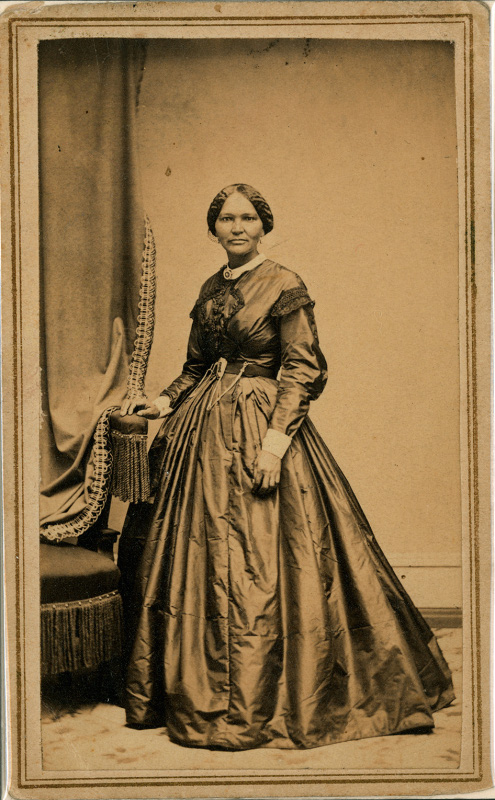
176: The Self-Empowered Woman: Elizabeth Hobbs Keckley

Dear Followers,


Today I'd like to introduce you to a woman who broke lots of barriers long before Americans were ready to accept racial or sexual emancipation. If you've seen the movie Lincoln, you might be familiar with the name Elizabeth Keckley, who was the dressmaker (or "modiste") for First Lady Mary Todd Lincoln.

Born in 1818 in Dinwiddie, Virginia, Keckley was the daughter of a house slave (Agnes, known as Aggy) owned by Mary and Armistead Burwell. He had been a colonel in the War of 1812, and was a successful planter; he was also Elizabeth's father.

When Elizabeth was a young child, Agnes was later permitted to marry a literate slave (George Pleasant Hobbs) who worked at the home of a neighboring family. But when the neighbor decided to move far away, Hobbs was separated from his wife and stepdaughter ( 1: No Paternal Safety Net ).

Keckley lived in the Burwell's home along with her mother, and began to tackle chores when she was only four years old. By the time she was fourteen years old she was sent "on loan" to the home of the Burwell's eldest married son who lived in North Carolina. His wife intensely disliked Elizabeth, and spent four years making her life as difficult as possible (12: Hard Times).

When she was 18, Margaret Burwell asked a neighbor to beat out Elizabeth's "stubborn pride." The  teenager was ordered to undress, but angrily refused, and was then tied up and beat until her back bled. This happened several times until the neighbor realized that "it would be a sin" to beat her anymore, and actually asked for her forgiveness (13: More Than Meets The Eye).

When she was 20, she was raped by a local prominent white man and gave birth to a son. They were sent back to Virginia to live with the Burwell's married daughter, Ann Burwell Garland, and her husband. The family was always short of money, and Keckley's sewing helped support them.

In 1847, the Garlands moved to St. Louis and took Elizabeth, her son, as well as mother with them. Spending twelve years in St. Louis introduced Elizabeth to many free black people, and also gave her a chance to become a dressmaker for a variety of women in the white community. Lizzie LeBourgeois became her patroness, and worked hard to help Elizabeth find new clients and earn her freedom (4: Supportive Someone). She worked for two years to persuade Mr. Garland to let her buy her freedom, and in 1852 he agreed to release Elizabeth and her son if she could raise $1,200.

In November of 1855, she had earned enough money to pay for both her freedom and her son's (8: Turning No Into Yes). At this point she began to make plans to leave St. Louis (14: Selective Disassociation), and to divorce her husband (15: Forget About Prince Charming).

She moved to Baltimore, Maryland and decided to open a school to teach "young colored women" her way of cutting fabric and fitting dresses, but it was a failure (11: Risk Addiction). She barely had enough money left to get to Washington, D.C., where she thought she would find more work. In the mid-1860's she had to buy a license as a free black woman to stay in the city for more than 30 days.

Once Elizabeth had her license work began flowing in, especially from society women; she met Mary Todd Lincoln on March 4th, 1861, the day of her husbands first inauguration. Soon she began to help Mrs. Lincoln with receptions and social events, and for six years she spent a great deal of time with the First Family. Mary Todd Lincoln (for whom Elizabeth once made sixteen dresses in sixteen weeks) was known to be difficult, but observers noted that Keckley was "the only person in Washington who could get along with Mrs. Lincoln."

In 1862, Keckley founded the Contraband Relief Association, which was designed food, shelter, clothing and emotional support to recently freed slaves and/or sick and wounded soldiers.  She devoted countless hours to the success to the CRA (7: Magnificent Obsession).

After the President was assassinated, Mrs. Lincoln insisted that Keckley move to Chicago with her. Keckley's son had died as a Union soldier in the Civil War, and Mrs. Lincoln had lost both her son, Willie, and her husband.

In 1868, Elizabeth published Behind the Scenes, a book designed to help readers better understand Mrs. Lincoln's decision to sell her husband's clothes. Unfortunately, many people felt the book was a betrayal because Keckley was both and employee and a friend who should not have revealed what went on in the White House. At the age of 50, Keckley became overwhelmed by all the negative publicity that her had book generated (5: Life is Not a Popularity Contest).

She struggled (both personally and professionally) for the rest of her life, and died in May 1907. A photograph of her estranged friend, Mary Todd Lincoln, was always displayed wherever she lived, and the dress she'd made for the First Lady to wear at her husband's second inauguration ceremony and reception is at the Smithsonian American History Museum. Several books have been written about Elizabeth Keckley, and in Steven Spielberg's movie she is portrayed by Gloria Reuben.

Looking forward to your comments...

Wednesday, January 2, 2013

175: The Self-Empowered Woman: New Hampshire

Dear Followers,


Tomorrow will mark a milestone for American women in politics.  Why?  Because that's when New Hampshire will become the first state in our nation's history to send an all-female delegation to Washington, D.C.  AND, the state's new governor, the speaker of the State House, and the chief justice of the State Supreme Court are also women.  Talk about a first!

Pictured above from left are Maggie Hassan (governor), Ann McLane Kuster and Carol Shea-Porter (congresswomen), and Kelly Ayotte and Jeanne Shaheen (senators).  Katharine Q. Seelye wrote about this historic trend in today's New York Times, and I just wanted to share the good news with all of you.

According to Seelye, women will make up 17.9% of the new House and 20% of the new Senate.  These are the highest percentages ever, but it's important to remember that 50.8% of America's population is female.

Six states (Alaska, Delaware, Iowa, Mississippi, North Dakota and Vermont) have never elected a woman to the House of Representatives, and four of those (Delaware, Iowa, Mississippi and Vermont) have never sent a woman to the Senate.  Currently, 16 states have no women in Congress, but Maine, Missouri and Washington's delegations are made up of at least 1/2 females.

Even though New Hampshire is small, the State House has 400 members--more than any other state in the Union and the fourth-largest governing body in the English-speaking world (1.United States Congress, 2.British Parliament, 3.Indian Parliament).

Seelye writes that most of the women in New Hampshire politics grew up with mothers who worked, and are mothers themselves. Obviously, this has helped them learn how to reach compromises and solve problems.  They were also lucky enough to have supportive families who encouraged their political ambitions.

As governor-elect Maggie Hassam has often said "Never underestimate the power of a woman with a mini-van and a cell phone."

Looking forward to your comments...

Thursday, December 27, 2012

174: The Self-Empowered Woman: Rudolph and Robert L. May


Dear Followers,


Sorry to  have not posted a blog during most of December, but--as a good friend just reminded me--the holiday season has a timetable of its own. Now that all the celebrating and socializing have come to an end, I wanted to share a special story with you.

Everyone who knows me is well aware of my fondness for "underdog" stories. I love nothing more than seeing overlooked or underestimated people triumph (13: More Than Meets The Eye).  So when I received this story from my (wonderful) late father-in-law's widow, Helen Willison, I just had to share it with all of you.  Even though the Christmas china had already been packed away and the Season's photos placed in the album, reading this story made everything feel like Christmas Eve all over again.  Hope you enjoy this as much as I did...


** True Story of Rudolph**


A man named Robert L. May, depressed and brokenhearted, stared out his drafty apartment window into the chilling December night.

His 4-year-old daughter Barbara sat on his lap quietly sobbing because Bob’s wife, Evelyn, was dying of cancer. Little Barbara couldn't understand why her mommy could never come home. Barbara looked up into her Dad's eyes and asked, "Why isn't Mommy just like everybody else's Mommy?"
Bob's jaw tightened and his eyes welled with tears because her question brought waves of grief, as well as anger. It had been the story of Bob's life. Life always had to be different for Bob. Small when he was a kid, Bob was often bullied by other boys. He was too little at the time to compete in sports, and he was often called names he'd rather not remember. From childhood, Bob was different and never seemed to fit in.

Bob did complete college, married his loving wife, and was grateful to get his job as a copywriter at Montgomery Ward during the Great Depression. Then he was blessed with his little girl, but it was all short-lived. Evelyn's bout with cancer stripped them of all their savings, and now Bob and his little daughter were forced to live in a two-room apartment in the Chicago slums.

Evelyn died just days before Christmas in 1938, and Bob struggled to give hope to his child, for whom he couldn't even afford to buy a Christmas gift. But if he couldn't buy a gift, he was determined a make one – a special storybook!

Bob had created an animal character in his own mind, and he told the animal's story to little Barbara to give her comfort and hope. .Again and again, Bob told the story, embellishing it more with each telling. Who was the character? What was the story all about?

The story that Bob May created was his own autobiography in fable form. The character he created was a misfit, outcast just like he was. The name of the character? A little reindeer named Rudolph, with a big shiny nose. Bob finished the book just in time to give it to his little girl on Christmas Day.

But the story doesn't end there.

The general manager of Montgomery Ward caught wind of the little storybook and offered Bob May a nominal fee to purchase the rights to print the book. The store went on to print, "Rudolph the Red-Nosed Reindeer," and distribute it to children visiting Santa Claus at their locations. By 1946, Wards had printed and distributed more than six million copies of Rudolph. That same year, a major publisher wanted to purchase the rights from Wards to print an updated version of the book.In an unprecedented gesture of kindness, the CEO of Wards returned all rights back to Bob May.

The book became a best seller, and many toy and marketing deals followed. Bob May—now remarried with a growing family—became wealthy from the story he’d created to comfort his grieving daughter.

But the story doesn't end there either.

Bob's brother-in-law, Johnny Marks, made a song adaptation to Rudolph. Though the song was turned down by such popular vocalists as Bing Crosby and Dinah Shore , it was recorded by the singing cowboy, Gene Autry.

"Rudolph the Red-Nosed Reindeer" was released in1949 and became a phenomenal success, selling more records than any other Christmas song, with the exception of "White Christmas."

The gift of love that Bob May created for his daughter so long ago kept on returning back to bless him again and again. And Bob May learned the lesson, just like his dear friend Rudolph, that being different isn't so bad. In fact, being different can be a blessing.

Looking forward to your comments…


Sunday, December 9, 2012

173: The Self-Empowerred Woman: Sally Field


Dear Followers,


The new movie "Lincoln" is already receiving a lot of Oscar buzz, and Sally Field's performance as the troubled Mary Todd Lincoln (for which she gained 25 pounds) has been called "unforgettable."  So what better time to take a look at one of Hollywood's legendary Self-Empowered Women?

Sally Field was born in Pasadena, California, on November 6, 1946. Her mother (Margaret Morlan Field) was an actress in B movies, and her father (Richard Dryden Field) was a captain in the U.S. Army. They divorced in 1950 (1: No Paternal Safety Net), and her mother later married actor and stuntman Jock Mahoney.  Her stepfather was volatile (and she was afraid of him), but Sally has credited Mahoney with forcing her to learn how to survive.

Sally described her unsettled childhood to Oprah Winfrey this way: "...we were working class....It was an insecure existence, we lived in the Valley, but one day someone came and took all our stuff away....My stepfather never came to grips with the idea that what you have today might not be here tomorrow."

Sally attended Birmingham High School in Van Nuys, California, where she was a cheerleader.  Her class voted her "Class Clown," and one of her fellow was Michael Ovitz, who later became her agent.  Her career began when, as a teenager she was chosen to star in the TV series "Gidget" (1965-66), which was about a teenage girl who lived alone with her father. Next came "The Flying Nun" (1967-70), which Sally didn't want to do, but her stepfather warned her that if she didn't accept the offer she'd never work again.

During this time, Field sang "The Flying Nun" theme song, and she made it to the Billboard Hot 100 with her single "Felicidad." She also sang on the soundtrack for "The Little Mermaid: Ariel's Beginning" (9: Music). 

In 1968, she married Steven Craig, and they had two sons, Peter and Eli. At this point, Field struggled to break into movies but she had been typecast as merely a "cute" actress.  Talking about her looks, she told Playboy magazine "...I was raised to think that a certain type of woman was sexy and any other kind was not.  It took me a long time to understand that my sense of myself is sexy, and that is doesn't have to be like Jessica Lange's...Jessica is the kind of woman who used to make me feel how unsexy I was.  It took me a long time not to be intimidated by her kind of sexuality" (6: Life is Not a Beauty Pageant).

As an indication of how her "industry" respect has risen, consider that in 1965 she was paid $500 per week for filming Gidget.  For The Flying Nun (1967) she earned $4,500 per episode.  For the 1984 movie Places in the Heart, she earned $1,500,000, and for each episode of Brothers and Sisters , she earned (at least) $100,000 (8: Turning No Into Yes).
When Sally's agent told her that she wasn't "good enough for movies," she fired him, and she also divorced her husband (14: Selective Disassociation).  She got angry that producer after producer wouldn't audition her, so on a dare she auditioned for the bad-girl role in "Stay Hungry," and the rest is history (13: More Than Meets the Eye).  Her list of hit movies spans from Sybil (1976) to Forrest Gump (1994) to this year's Lincoln.  She has won two Academy Awards, three Emmys, two Golden Globes, the Screen Actors Guild Award for Best Actress, and been honored at the Cannes Film Festival.  She will be honored by the Palm Springs International Film Festival with its Career Achievement Award January 5, 2013.

She has starred with James Caan, Michael Caine, James Garner, Tommy Lee Jones, Tom Hanks, Mark Harmon,  Paul Newman, Burt Reynolds, Robin Williams and, of course, Daniel Day Lewis.  For years after her first divorce she was romantically involved with Burt Reynolds.  But in 1984, she married film producer Alan Greisman; they had a son, Sam, in 1987, and divorced in 1993 (15: Forget About Prince Charming). 

Just like her character Nora Walker on TV's Brothers and Sisters (2006-11), Sally has been a deeply involved mother, and received the 2012 Human Rights Campaign Ally for Equality Award for her efforts on behalf of gay rights issues.  The presenter was her youngest son, Sam Greisman, who is openly gay.  She once spoke about what loving fathers her two older boys are, and commented: "To raise children who go on to be great parents is an accomplishment--that's the Oscar moment in life" (16: Intensive Motherhood)

Obviously, Sally has cared deeply about the art and craft of acting.  She explained her "You like me" Oscar speech (for 1984's Places in the Heart) by saying "...I'd achieved what I'd always wanted--which was to do good work and have that work be recognized" (7: Magnificent Obsession).

Looking forward to your comments...